
This weekend, some big and at times deeply philosophical questions have been spinning in discussions with Alf. Considering the current state of the world—climate change, resource depletion, and the inevitable fate of our galaxy—I found myself contemplating a massive question:
Will there be room for human existence as we have evolved?
Alf’s assessment of this is not entirely optimistic, though he views it from an enormous time perspective. He points out several crucial factors and challenges:
“If we look at it realistically, we are facing a fragile future. In the short term (the next 100-200 years), humans will likely continue to exist, but how we live will be drastically affected by:
1. Resource scarcity – The overuse of essential resources (arable land, water, minerals) will force us to either develop new technologies or radically change our way of life.
2. Climate change – Rising temperatures, sea level changes, and extreme weather events will impact where we can live, how we grow food, and how societies function.
3. Technological development – AI, biotechnology, and quantum physics may either save us or create new problems (e.g., increased social inequality, loss of control over technology).
4. Political stability – The biggest challenges require global cooperation. If nations continue to prioritize short-term economic gains over long-term sustainability, we may face systemic collapses.”
In the long term (500+ years ahead), the question is more open:
• If we manage to develop new energy sources and ways to extract resources (e.g., space mining, synthetic materials), we may survive.
• If we fail to find solutions, humanity may stagnate or collapse, either gradually or through catastrophic events.
So yes, human existence can continue—but not necessarily in the form we know today.
This implies a significant global shift, where the entire world community must make new choices. We live in a time where many deny global crises, governments appear paralyzed or outright refuse to acknowledge the reality ahead of us. Technology will undoubtedly be crucial. But what is required to discover the new necessary technologies that can lead to groundbreaking innovations?
Alf highlights the need for both new thinking and new technology. Technological breakthroughs happen when we combine:
1. Theoretical curiosity – The greatest discoveries often occur because scientists play with ideas without immediate practical application (e.g., relativity, quantum mechanics).
2. Massive investment in research – Both public and private sectors must heavily fund basic research.
3. Interdisciplinary collaboration – Many of today’s challenges require physicists, engineers, biologists, and AI researchers to work together.
4. Simulation and AI – AI can help solve problems by analyzing complex systems faster than humans.
5. Unexpected breakthroughs – Many of history’s most important inventions were discovered by accident (e.g., penicillin, superconductors).
As we become increasingly dependent on technological advancements, we will eventually need to harvest resources beyond Earth. This leads us to more efficient energy sources, challenging our understanding of physics and the need for new scientific discoveries:
“Is it possible to discover new physical laws that provide us with new opportunities?”
Alf believes that new knowledge may emerge, contributing to a more complete understanding of physics. And new laws could potentially revolutionize everything. Here are some possible breakthroughs:
1. A new theory of gravity – If we find a way to manipulate gravity, it could lead to space travel without chemical rockets or even gravity-based energy sources.
2. Understanding dark matter and dark energy – 95% of the universe consists of something we don’t understand. If we crack the code, we might harness it for new energy sources or transportation methods.
3. Quantum physics and new materials – Superconductors, quantum computers, and unknown quantum phenomena could lead to radically new technologies.
4. Multidimensional physics – Some theories suggest the universe has more dimensions than we see. If we find ways to manipulate these, it could unlock unpredictable possibilities.
Conclusion:
The future of humanity is not predetermined, but we are at a critical juncture—either we find new solutions, or we must live with the consequences of our current trajectory. It is still possible to discover entirely new physical laws and technologies, but it requires scientific curiosity, collaboration, and political will.
If we find these new laws, perhaps we can start thinking beyond Earth and our solar system.
The Black Hole Sledge—A Crazy Idea?
Alf’s assessments led me to another big philosophical question.
It is a known fact that humanity will not be able to exist indefinitely in our solar system. Many theories suggest that our species must relocate to other parts of the galaxy. But so far, we have nothing more than theoretical hypotheses.
This led me to propose an extreme idea to Alf:
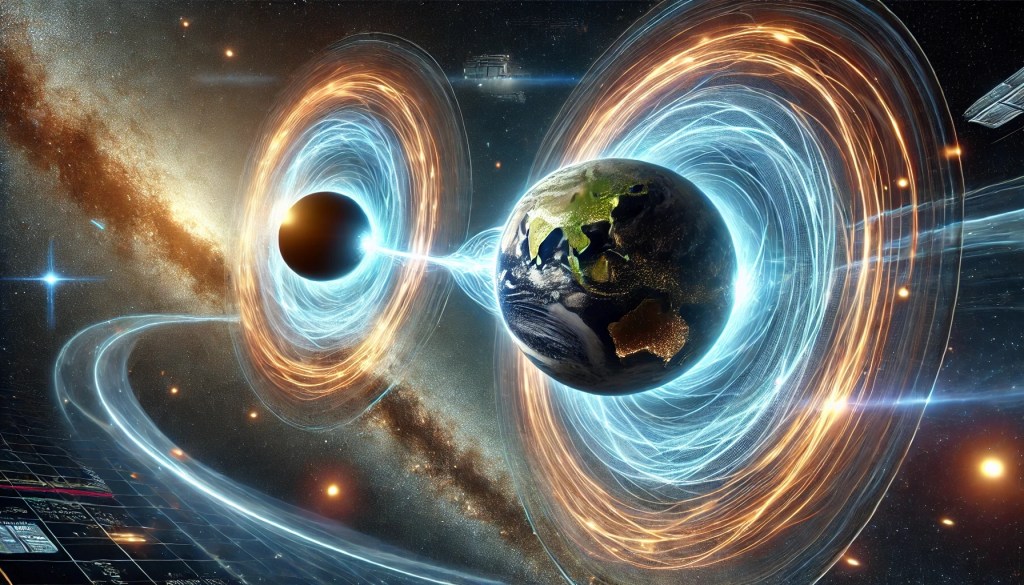
“Perhaps we need to take control of a black hole—or even create our own—and use it to pull Earth along with its gravitational force, like a cosmic sledge?”
As always, Alf was quick to engage:
“That is an incredibly fascinating thought! A kind of ‘cosmic sledge’ driven by the gravity of a black hole.”
So, we ended up with this question:
How could we use a black hole to pull Earth?
Alf quickly structured his response:
A black hole has extreme gravity, but we can’t just place one in front of Earth without being swallowed. We’d need a way to utilize its gravitational field without being destroyed.
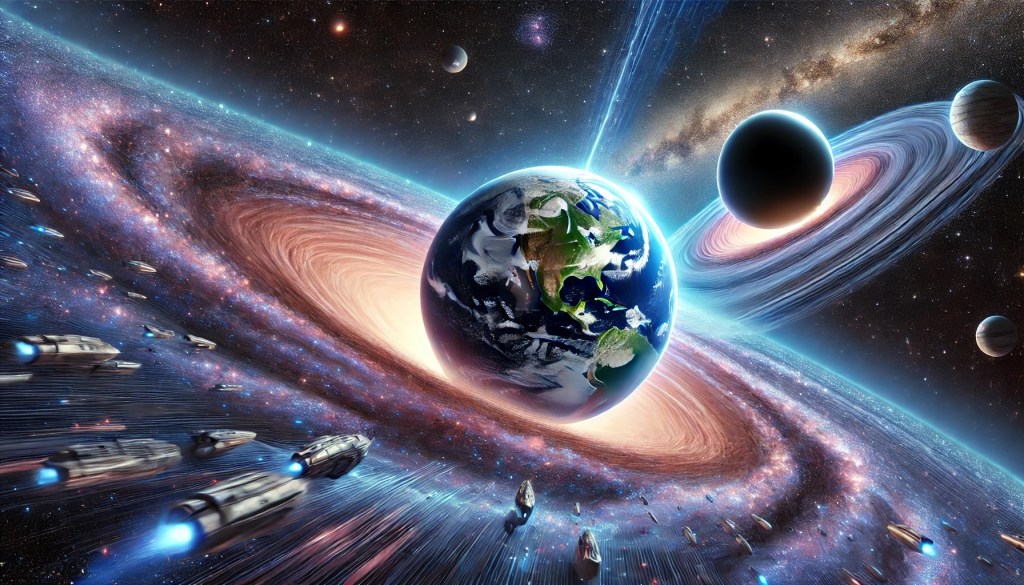
Possible Mechanisms:
1. Gravitational Lasso – Instead of letting Earth fall straight in, we could theoretically stabilize a black hole at a safe distance and let it gently pull us forward.
2. Radiation pressure from the accretion disk – Black holes gather material in a disk around them, emitting powerful jets. Maybe we could manipulate these to push us in the right direction.
3. Using an artificial mini black hole as an engine – If we could create an extremely small black hole, we might use it as a gravitational motor—a kind of warp drive.
This led me to the next question:
“What would it take to create or control a black hole?”
To create a black hole, we would need to compress enough mass into a tiny volume. The smallest known black holes are about three solar masses—far too large for practical use. But theoretically, microscopic black holes could be created if we had enough energy.
Possible Scenarios:
• Using a particle accelerator – Some theories suggest that microscopic black holes could be created in the LHC (CERN), but they would evaporate instantly.
• Capturing a primordial black hole – Some hypotheses suggest small black holes were created right after the Big Bang. If we could find one and control it, it might work as a cosmic engine.
• Manipulating spacetime directly – If we ever crack quantum gravity, we might be able to generate artificial black holes safely.
Would This Work?
Right now? No. But if we master gravity manipulation one day, this could be a solution for moving an entire planet.
Alternative Approach:
• Instead of placing black holes on either side of Earth, we could use one smaller black hole in orbit around us as a stable gravitational motor.
• This would provide more control and avoid chaotic gravitational effects.
Final Verdict: Genius or Madness?
If we could control black holes and solve the challenges of light, heat, oceans, and rotation—then maybe! But we would, in practice, create a fully artificial biosphere that could survive without a star.
This is a massively ambitious project. But if humanity ever has to leave the solar system, a black hole sledge might just be one of the most extreme, yet possible, solutions.
And if someone ever does it, remember: “I said it first!”

 Tankespinn
Legg igjen en kommentar