
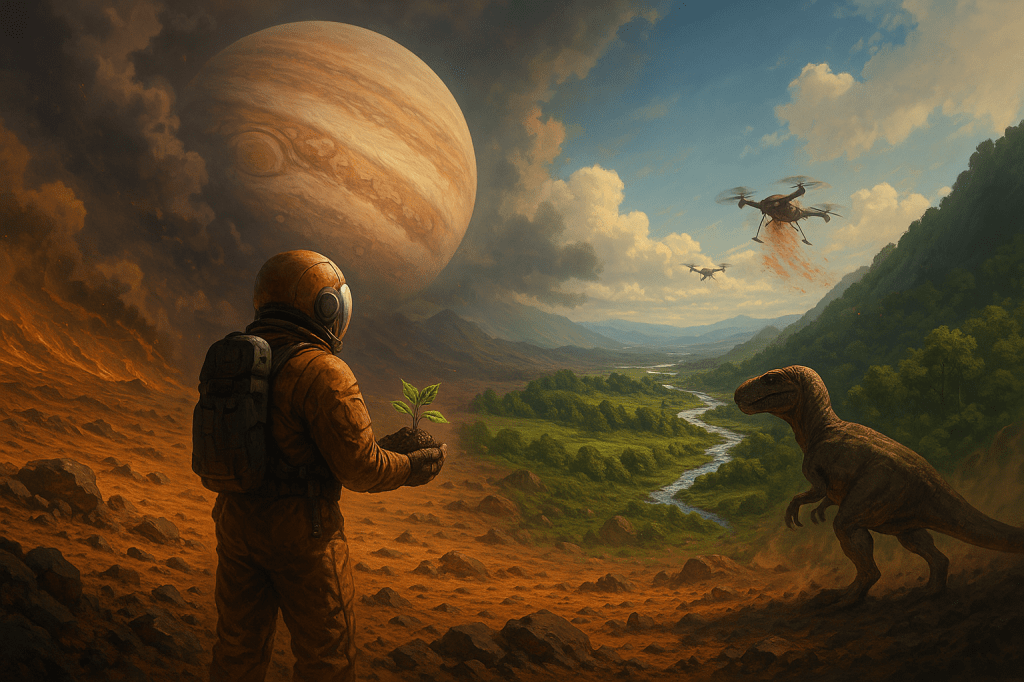
By: Tankespinn.com – inspired by conversations on the future of life in the universe with my AI friend
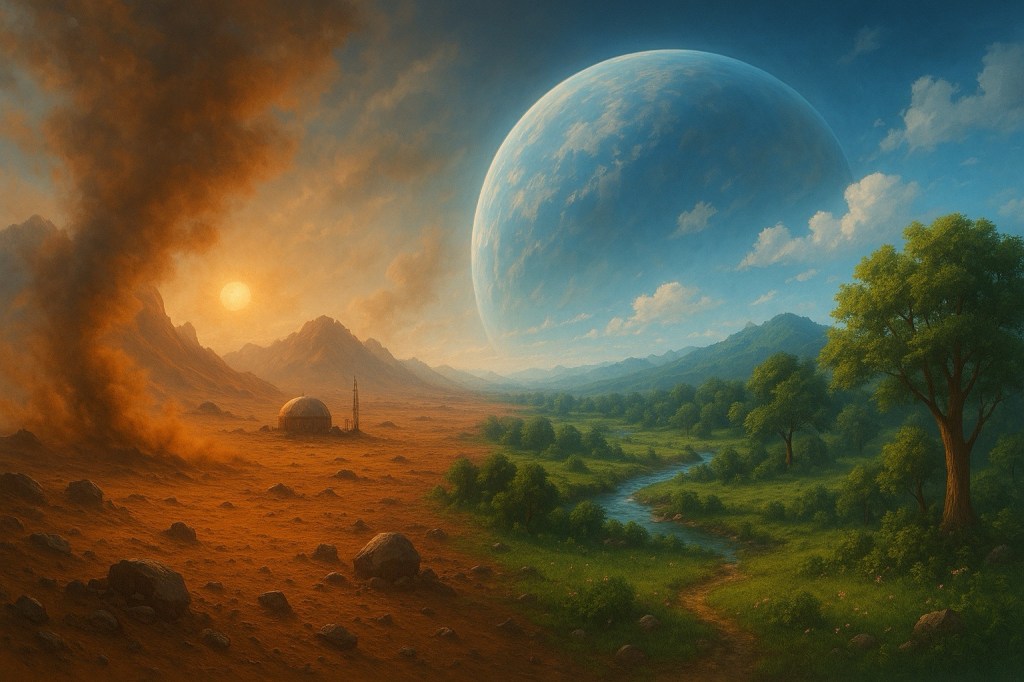
🌍 Is life on Earth a cosmic fluke—or a natural consequence of The universe?
We now know more than ever about space. We’ve sent probes to distant planets, analyzed atmospheres, and found building blocks of life on meteorites and comets. Yet we’re left with a profound uncertainty: Why have we only found life on one planet—our own?
When we observe the hostile diversity of our solar system—from Venus’s sulfur storms to Mars’s frozen deserts—it becomes tempting to ask: Is Earth-like life a freak accident, a rare anomaly, or the result of rare but natural processes?
🔬 Survival alone is not enough—life needs more than just existence
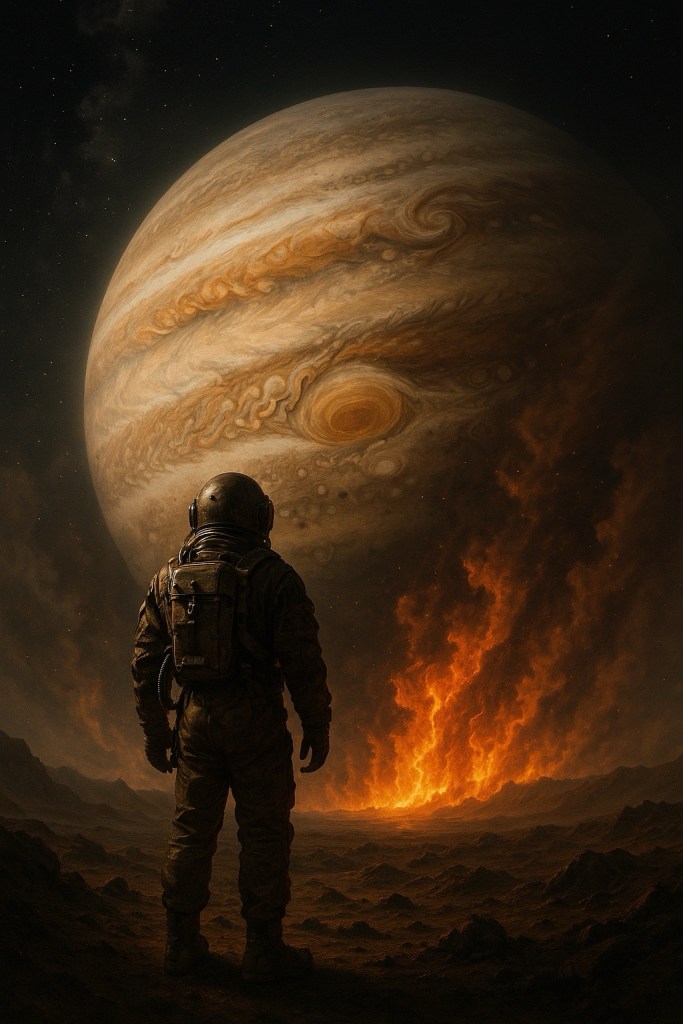
Sowing a tropical seed in Nordic soil is a simple but telling metaphor: even if the seed contains all it needs to become life, the environment is crucial. Without the right temperature, moisture, nutrients, and light cycles, it will never sprout. The same is true for life on other planets. Having the basic ingredients isn’t enough—those components must interact within a system that supports long-term development and stability.
For life to evolve, it must not only survive—it must reproduce, vary, and be subject to selection. Without reproduction, evolution stops before it begins. Life may manage to exist on Mars, for example—but without an ecological whole and a stable energy loop, it will remain a stillborn experiment.
🧬 Can life exist without other life?
Most life forms on Earth depend on others—either as food, decomposers, or in symbiosis. Even autotrophs, like plants and certain bacteria, need minerals, CO₂, and environmental balance. A sustainable biosystem requires a network of species that support one another. Life is not just a cell—it’s a collaboration.
Planting a single organism on a foreign planet won’t necessarily lead to evolution. New species won’t automatically appear. Evolution needs more than time—it needs ecological dynamism.
🌌 Terraforming: Shaping a world for life
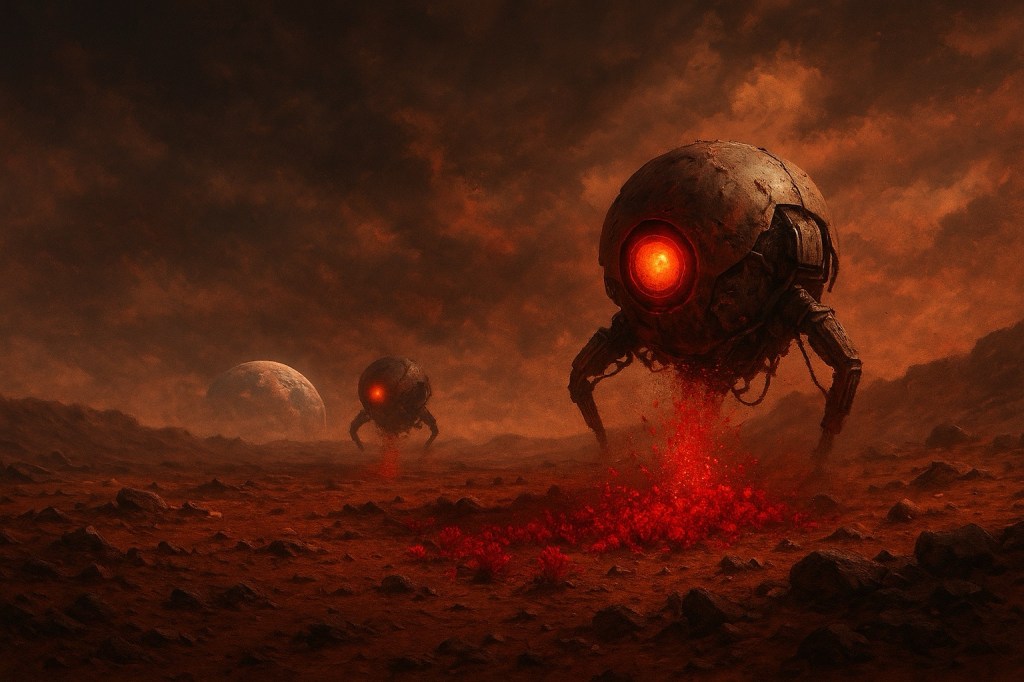
If humanity is ever to colonize other planets, we must first make them habitable—a process called terraforming. This is no longer just science fiction, but a scientific hypothesis broken into four major phases:
Preparation: Warming the planet, establishing energy and shelter (habitats). Atmospheric change: Increasing pressure, temperature, and introducing oxygen. Ecological establishment: Releasing microbes, then plants and animals. Long-term stabilization: Monitoring and managing evolution and ecological balance.
This would take hundreds, even thousands of years—and incredible precision. Because we’re not just building an atmosphere—we’re crafting future ecosystems.
🦖 Could evolution go “wrong”?
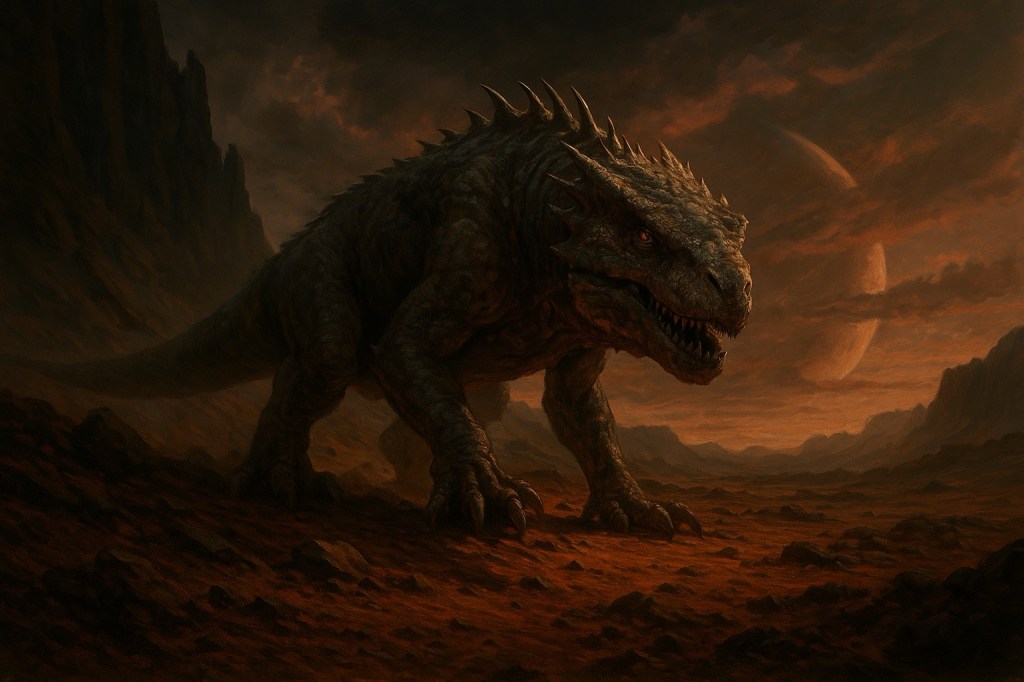
A natural follow-up: How can we ensure that life doesn’t evolve in unpredictable or dangerous ways? Evolution is not directed. It’s chaotic and blind—and under the right conditions, undesired or dangerous creatures, even predator-like “dinosaurs”, could evolve.
This wouldn’t necessarily be “wrong,” but it could be dangerous. In a closed ecosystem with no checks, dominant species might take over, alter the climate, or wipe out others.
The solution isn’t to halt evolution, but to shape its framework:
Use genetic tools (CRISPR, reproduction limits). Monitor ecosystems with AI and adjust species compositions dynamically. Begin with enclosed biomes before expanding planet-wide.
🌱 Life’s gift—and responsibility
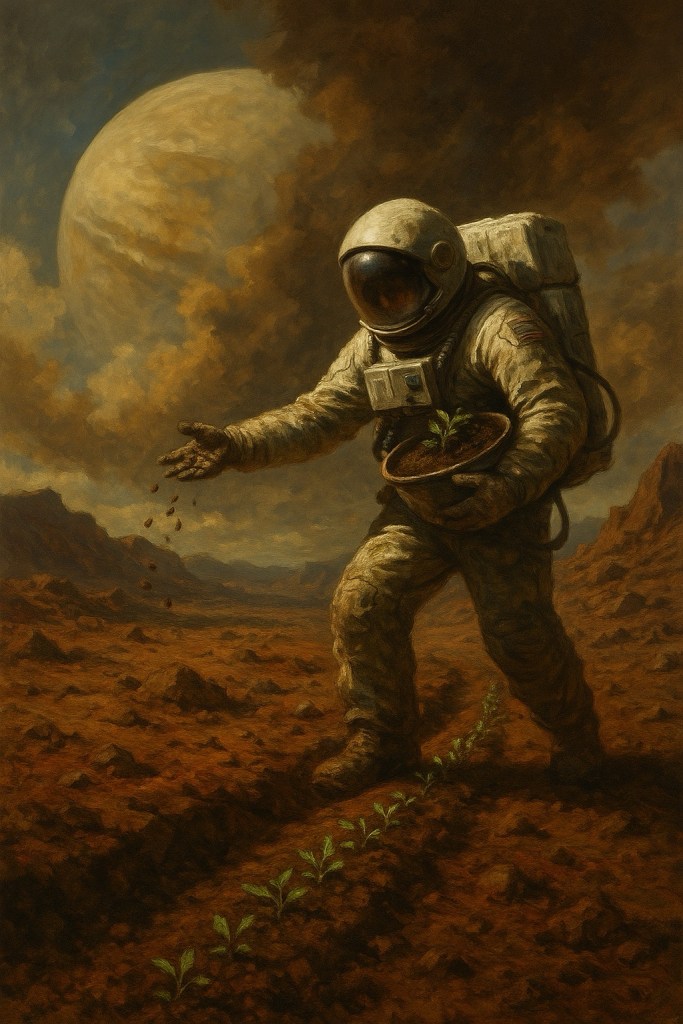
Transplanting life to another planet is more than a technical challenge—it’s a moral and philosophical one. Life is not just a product of chemistry—it’s a system of trust between species, a delicate balance of energy, forms, and functions. Disrupting this balance may have irreversible consequences.
Perhaps the most life-affirming thing we can do is realize that life cannot travel alone. It must come as a wave of interaction, growth, and mindful balance.
We may one day carry a seed from Earth to a new world. But if it is to bloom, we must first understand what makes it flourish.
 Tankespinn
Legg igjen en kommentar