
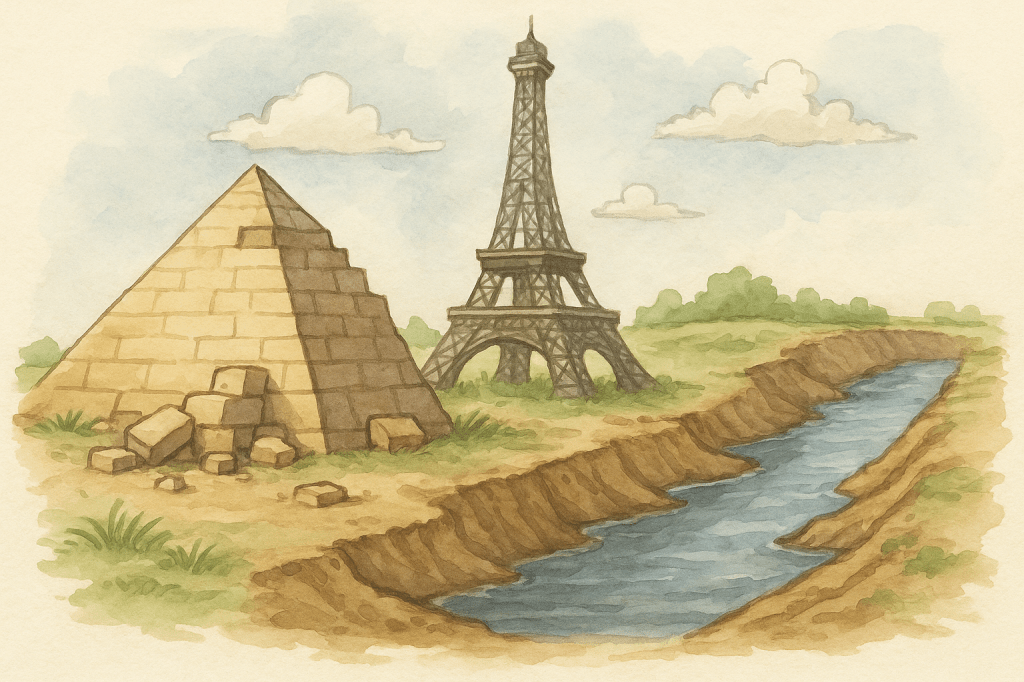
What history would’ve looked like if humanity had the attention span of a swipe: half a pyramid, a starter-pack Eiffel Tower, and the world’s most determined puddle.
Imagine taking the modern fitness mentality of viral bursts, 12-week enthusiasm, zero long-term planning and attention spans measured in swipes — and putting those same people in charge of three of history’s most ambitious construction projects: the Pyramids, the Eiffel Tower and the Panama Canal.
What would we be left with in 2026?
A global architectural comedy.
The Pyramids: “12 Weeks to Ancient Summer Shape”
With TikTok-style supervisors, the pyramids would launch with massive hype.
Day 1: “We’re building the largest monument in human history! Full throttle!”
Day 3: “New trend! We only use white limestone if it matches the sunset aesthetic.”
Day 11: “Bored. Let’s build a tiny practice-pyramid for content.”
Day 18: Everyone pauses construction to film behind-the-scenes reels.
The project timeline would look like:
Weeks 1–3: Intense work, huge confidence, zero strategy.
Weeks 4–6: Endless redesigns because one perfectly angled stone went viral.
Weeks 7–9: Total stagnation as supervisors jump to more exciting trends.
Weeks 10–12: A massive announcement of “Pyramid 2.0” that never materializes.
Result in 2026:
A scattered pile of stone blocks arranged in an accidental staircase — ideal for drone shots, catastrophic for symmetry. Tourists nickname it “The Egyptian Outdoor Theater for Sudden Collapse.”
The Eiffel Tower: “Built in Four Episodes — Episode Three Missing”
Under short-term leadership, the Eiffel Tower would follow a predictable pattern:
Phase 1 — Euphoria
Boundless optimism, no engineering logic, total confidence.
Phase 2 — Identity Crisis
Three weeks in, a trending architect video from New York changes the design. Suddenly the tower must be “soft steel aesthetic.”
Phase 3 — Stagnation
Half the workforce disappears to chase newer and more exciting projects. Supervisors release progress videos instead of actual progress.
Phase 4 — Reinvention
The tower is rebranded as a “pop-up experience.”
“We don’t need to finish it — the process is the art.”
Paris 2026:
A 43-meter metal skeleton resembling a telecom mast with ambition issues.
The remaining steel litters the Champ de Mars as accidental art installations.
The Panama Canal: “Seasonal Digging Interrupted by 137 New Trends”
The real canal required planning, global coordination and relentless execution.
Its TikTok-era counterpart?
Weeks 1–2: Everyone digs with enthusiasm. No idea why.
Week 3: A minimalistic canal trend goes viral → full redesign.
Weeks 4–6: Motivation evaporates. A new fitness challenge steals attention.
Week 7: Rain fills the trench; the project is rebranded as “Panama Lake.”
Weeks 8–12: A hype campaign for “Mega Canal 2.0” launches — no one shows up.
Global trade in 2026:
Cargo ships detour thousands of miles.
Panama becomes the proud owner of the world’s largest muddy puddle, documented almost entirely by drone footage.
Final Assessment: Hype Builds Nothing
Give trend-driven, algorithm-shaped managers the responsibility for massive projects and you get:
Monuments with a two-week lifespan.
Engineering that looks good from one angle but collapses in the wind.
Projects launched in fireworks and ending in damp smoke.
Big words with zero endurance.
A planet full of half-finished ideas and nothing built to last.
History would transform into a museum of abandoned prototypes, not masterpieces.
Major, demanding projects require people who can tolerate boredom, complexity and hard work without applause.
Without that, the pyramids become a backdrop, the Eiffel Tower remains a steel skeleton — and the Panama Canal turns into a giant rain puddle shaped by the attention span of a goldfish.
Ready for publishing.
 Tankespinn
Legg igjen en kommentar